- Home
- Water Testing
- Filtration
- Boreholes
- Pricing
- Our Articles
- 10 Tips Once You Have Decided to Put in a Borehole
- 10 Frequently Asked Questions When Owning a Household Filtration System
- Whole House Water Filtration System: Maintenance Guide
- The Benefits of Installing a Water Filtration System in Your Home
- The Hidden Journey of Water: Infrastructure, Quality and Risk
- Water Testing Before Water Filtration
- Water Compliance is Key
- Easy To Test Your Drinking Water With Our Water Test Kit
- The Easiest Way To Test Your Water.
- The Advantages of Using Filtered Ground Water in Your Home
- How to Save Water in South Africa: Practical Tips for Every Household
- Essential Guide to Water Testing in Cape Town: Is Your Water Safe?
- Why & How To Cover Your Back When It Comes To Your Water Quality
- SA Water Crisis
- Managing Effluent Water Testing
- SANS 241 Water Testing
- Why pH Isn’t Enough: The Hidden Danger Lurking in Your Water
- Businesses Need To Test Their Water
- Why You Need To Test Your Council Water
- Why Water Testing Is So Important
- Businesses Need A Water Audit
- It Is Vital To Maintain Your Filtration System
- Water Testing For Corrosive Water
- Contact Us
Water Testing
Our SANAS accredited water testing covers chemical, organic, microbiological and effluent laboratory analysis.
We test municipal, storage and ground water, and each source has very specific characteristics to monitor. Find out which water testing option is best suited to your water.
Trusted Water Quality Services For The Following Big Brands

It Is Now Easier Than Ever To Get Your Water Laboratory Tested
You choose how you want to get your water SANS 241 - SANAS Accredited
1. SANS Water come out to you
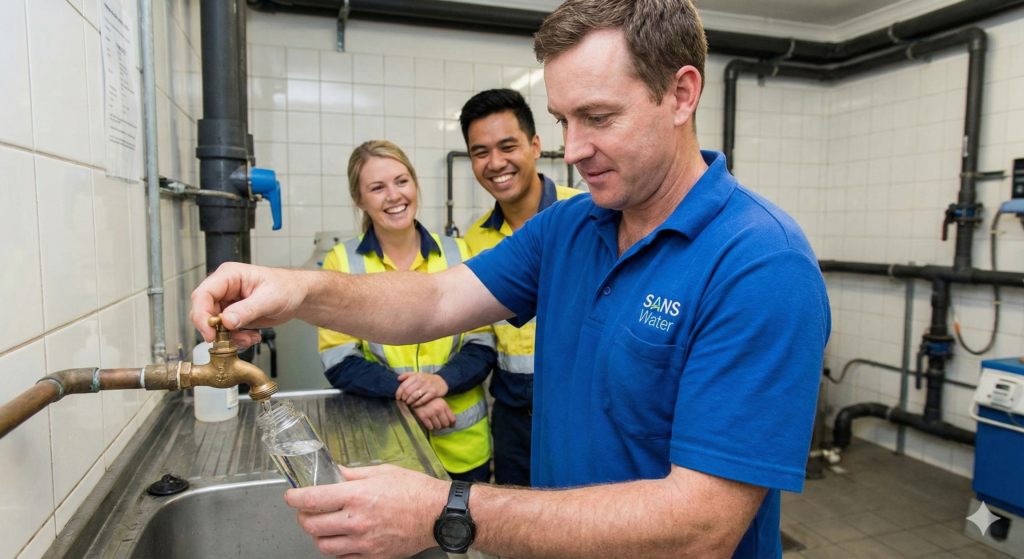
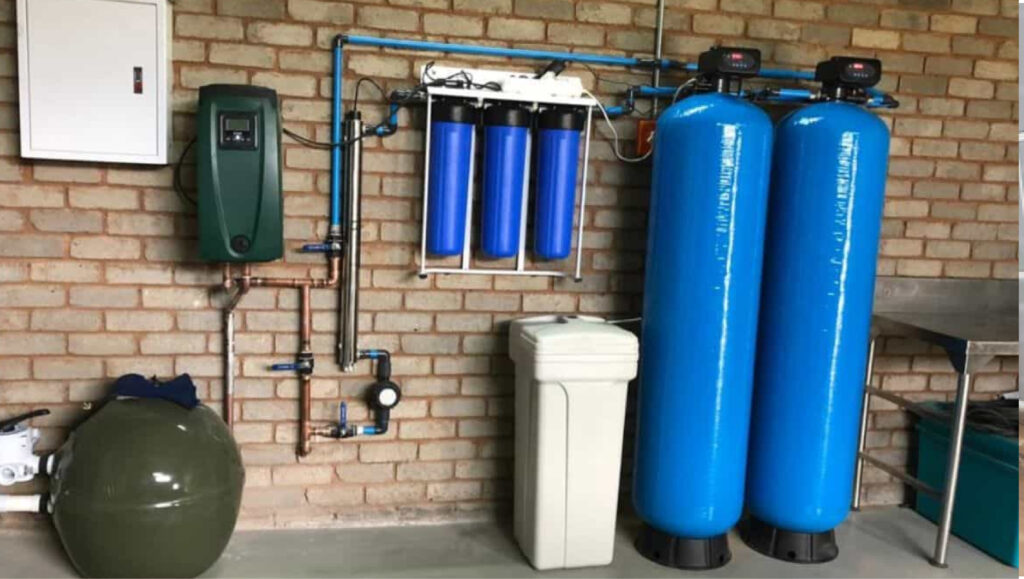
Do you want the personal touch? One of our highly experienced staff come out to your business or residence and personally collect a sample of your water, in addition to this we also deliver the sample directly to the laboratory. Clarity is key, which why we also offer ideas and advice on your current water infrastructure or filtration system, significantly improving your water quality. We can test ground water, municipal tap water, storage water and effluent.
2. We deliver a water testing kit
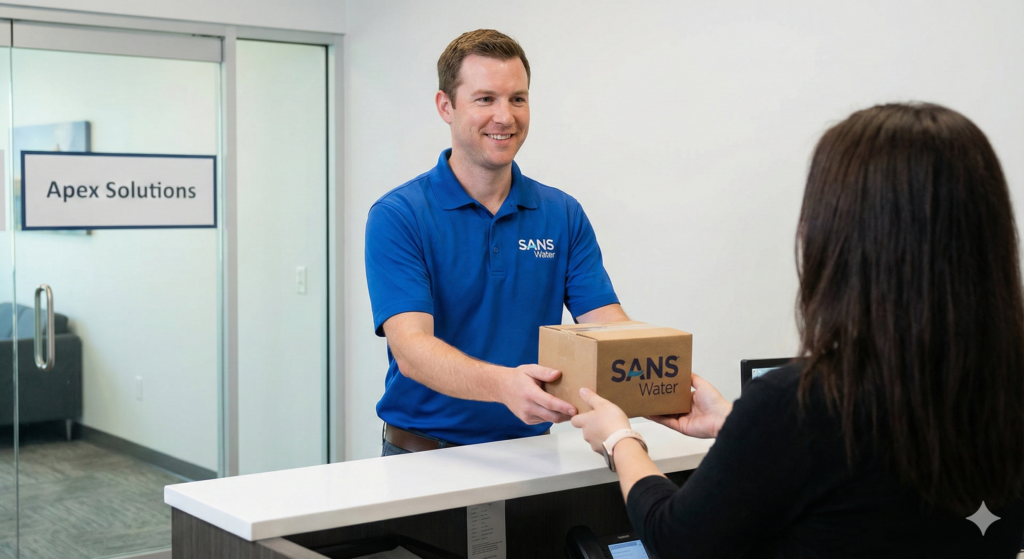
Know you need to test your water but never seem to have time to book an appointment or maybe too far from a SANAS Accredited laboratory. We can send out a test kit, regardless of where you are, directly to your door. You fill the two bottles from the water source you want to test, at a time suitable to you. Then, let us know when you are ready and we will collect the sample and take it directly to the laboratory.
Pure water is the world's first and foremost medicine
Have you already tested your water? If so, simply upload your results. Then, our advanced software will straightaway generate a detailed report that clearly explains what they mean. As a result, you gain valuable insights into your water quality, quickly, accurately and without the guesswork.
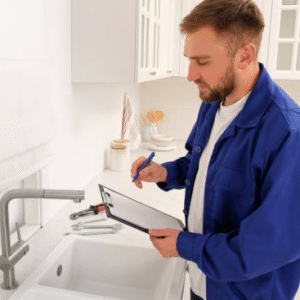
Get a personalised quote and discover exactly where water is being wasted. At the same time, you can pinpoint any billing inaccuracies. In addition, you will uncover opportunities to save, potentially reducing your water bill by up to 50%. Overall, it is a smart first step toward greater efficiency and lower costs.
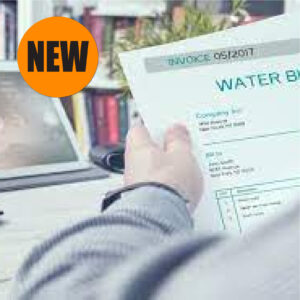
First, fill out our water usage form, and we’ll show you exactly what you should be paying. As a result, you can start saving money straight away. Furthermore, by identifying inefficiencies, we help you take control of your water costs with practical, data-driven insights.
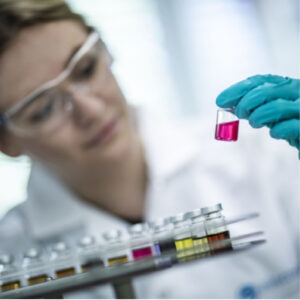
Water Test
Are you unknowingly corroding your pipes and fittings, clogging appliances, or bathing and cooking with substandard, hard water? If so, these hidden issues can affect both your health and your plumbing. Fortunately, they are preventable with proper testing and treatment.
Frequently Asked Questions
What are the benefits of using a SANAS accredited testing facility?
What are the benefits of using a SANAS accredited testing facility?
Choosing a SANAS accredited water testing laboratory is one of the most important decisions you can make when assessing the safety of your drinking water, borehole water, or municipal water supply. SANAS — the South African National Accreditation System — independently audits and certifies laboratories to ensure that their water testing methods, equipment, and reporting meet the rigorous standards set by international bodies such as ISO/IEC 17025.
When you submit a water sample to a SANAS accredited testing facility, you can trust that:
- Your results are accurate, reproducible, and legally defensible — critical for SANS 241:2015 compliance reporting.
- The laboratory uses validated, internationally recognised methods (such as M877 for E. coli and Total Coliforms, and M474 for trace metals) that are regularly audited for precision.
- Your Certificate of Analysis is accepted by regulatory bodies, municipalities, property developers, and industrial clients — unlike results from non-accredited facilities.
- Water filtration recommendations made on the basis of accredited water testing results are grounded in reliable science, not guesswork.
- You receive proper uncertainty of measurement disclosures with every water testing report, as required under ISO 17025.
For businesses, farmers, and property owners relying on borehole water or alternative water sources in South Africa, SANAS accredited testing is not merely best practice — in many contexts it is a legal and regulatory requirement. Always verify your laboratory’s SANAS accreditation number before submitting water samples for SANS 241 compliance testing.
South Africa, accredited water testing facility
How do I know if my borehole water is safe to drink?
How do I know if my borehole water is safe to drink?
Determining whether borehole water is safe to drink requires comprehensive laboratory testing assessed against the South African National Drinking Water Standard, SANS 241:2015. You cannot determine the safety of borehole water from appearance, taste, or smell alone — many of the most dangerous contaminants (including nitrates, heavy metals, and certain microorganisms) are completely undetectable by the senses.
Safe borehole water for drinking must pass water testing across three critical categories:
- Microbiological testing: E. coli must be undetected (None Detected / ND) in 100mL of water. E. coli is the primary SANS 241 indicator of faecal contamination. Total Coliforms must also be ND or within the SANS 241 limit of ≤10 cfu/100mL. Any detection of E. coli means the borehole water is unsafe to drink without treatment, regardless of how clear it looks.
- Chemical testing: Key parameters including nitrate and nitrite nitrogen (limit ≤11 mg/L N), ammonia nitrogen (≤1.5 mg/L), fluoride (≤1.5 mg/L), total dissolved solids (≤1,200 mg/L), and pH (5.0–9.7) must all fall within SANS 241:2015 recommended operational limits.
- Turbidity testing: Turbidity must be ≤1.0 NTU. Turbidity above this limit means the water contains suspended particles that can shield microorganisms from disinfection — even water that has passed microbiological testing may become unsafe if turbidity is not addressed through appropriate water filtration.
Once you have a full SANS 241 laboratory report, look for any parameters flagged as exceeding the recommended operational limits. Any exceedance — even a minor one like a turbidity result of 1.47 NTU — should be addressed with appropriate water filtration, treatment, or further investigation before the water is consumed.
For peace of mind, borehole water testing should be conducted at least every six to twelve months, or immediately after any heavy rainfall event, nearby construction activity, or change in the water’s appearance, taste, or odour.
results, water testing for drinking
What are the requirements for water testing compliance?
What are the requirements for water testing compliance?
Water testing compliance in South Africa is governed primarily by SANS 241:2015 — the South African National Standard for Drinking Water. Whether you are a municipality, property developer, agricultural operation, or private borehole owner, understanding the water testing compliance requirements that apply to your situation is essential.
The core water testing compliance requirements under SANS 241:2015 include:
- Microbiological compliance: Must confirm that E. coli is undetected (None Detected) and that Heterotrophic Plate Count (HPC) does not exceed 1,000 cfu/mL. These are the non-negotiable microbiological safety thresholds in SANS 241.
- Physical and chemical compliance: A full suite of chemical testing parameters must be assessed, including pH, turbidity, conductivity, total dissolved solids, nitrates, fluoride, chloride, sulphate, and alkalinity — all against the SANS 241:2015 recommended operational limits.
- Metals compliance: Testing must include analysis for heavy metals such as arsenic (≤10 µg/L), lead (≤10 µg/L), mercury (≤6 µg/L), chromium (≤50 µg/L), cadmium (≤3 µg/L), and others listed in SANS 241:2015.
- Accredited laboratory requirement: For regulatory and legal compliance, testing must be conducted by a SANAS accredited laboratory using validated methods. Results from non-accredited facilities are generally not accepted for compliance reporting.
- Documentation: Water testing compliance requires a formal Certificate of Analysis signed by a Technical Signatory, referencing the applicable SANS 241:2015 parameters and limits.
In addition to SANS 241, industrial water users may also need to comply with sector-specific regulations — for example, the National Water Act (Act 36 of 1998), the Water Services Act, and municipal bylaws may impose additional water testing and reporting requirements. Businesses operating cooling towers, food production facilities, or healthcare environments are typically subject to more frequent and more detailed water testing programmes.
standards, SANAS water testing
Can I get a laboratory report for my water testing?
Can I get a laboratory report for my water testing?
Yes — when you submit a water sample to a SANAS accredited laboratory, you will receive a formal Certificate of Analysis (COA) upon completion of the testing. This is the official laboratory report for your water testing, and it is a critical document for compliance, property transactions, health assessments, and water filtration planning.
A comprehensive water testing laboratory report will typically include:
- Your customer details, sample name, sample date and time, and the Set Point ID or location reference for the water sample tested.
- The full list of testing parameters assessed, including microbiological, chemical, and metals analysis.
- The measured result for each parameter alongside the SANS 241:2015 recommended operational limit for easy comparison.
- The method reference number used for each test parameter (e.g. M877 for microbiological testing, M474 for metals by ICP-MS).
- A clear indication of any water testing results that have exceeded the SANS 241 recommended limits.
- The name and signature of the Technical Signatory responsible for the testing results, along with the laboratory’s SANAS accreditation status.
- Notes on uncertainty of measurement and the basis on which results are reported.
Your laboratory report is the starting point for understanding what water filtration or treatment your water source requires. A qualified water treatment specialist or environmental health practitioner can use the COA to recommend the appropriate water filters, dosing systems, or other remediation measures needed to bring your water into SANS 241 compliance.
Most SANAS accredited laboratories in South Africa will issue your laboratory report within 5 to 10 working days of receiving your water sample, depending on the water testing parameters requested.
water testing report, water testing results document
What is the best way to test municipal water quality at home?
What is the best way to test municipal water quality at home?
While home water testing kits are available, they provide only a limited snapshot of water quality and cannot replace comprehensive laboratory testing for SANS 241 compliance. That said, there are practical steps you can take to monitor your municipal water quality at home and know when to escalate to professional water testing.
Home monitoring options for municipal water quality:
- Basic home testing kits: Available from hardware and pool supply stores, these typically test for pH, chlorine, total hardness, and sometimes nitrates. They are useful for quick checks but are not SANAS accredited and cannot be used for compliance purposes.
- Electronic TDS meters: A Total Dissolved Solids (TDS) meter measures the conductivity of your water as a proxy for dissolved minerals. A reading consistently above 500 mg/L warrants professional water testing. The SANS 241:2015 TDS limit is ≤1,200 mg/L, but elevated TDS can indicate water quality changes worth investigating.
- pH test strips or meters: Checking your municipal water pH at home gives a quick indication of whether the water falls within the SANS 241 range of 5.0–9.7. A pH below 6.5 may indicate corrosive water that could be leaching metals from your home’s pipework.
When to commission professional water test for your municipal supply:
- If you notice any change in the colour, taste, smell, or appearance of your tap water — even temporarily.
- If you have elderly family members, infants, or immunocompromised individuals in your household.
- Following any local water supply disruption, pipe burst, or water service interruption.
- If you are using point-of-use water filters and want to confirm their effectiveness with before-and-after water testing.
Professional water testing by a SANAS accredited laboratory remains the only way to obtain a full SANS 241 picture of your municipal water quality. For households using point-of-use water filters, annual testing is recommended to verify that your water filtration system is performing effectively.
filters for home, water testing kit South Africa
How do I interpret water testing results for corrosive properties?
How do I interpret water testing results for corrosive properties?
Interpreting the corrosive properties section of a SANS 241 water testing report can be daunting if you are unfamiliar with the parameters involved. The three key indicators of water corrosivity in a standard South African water tests report are the Langelier Saturation Index (LSI), pH, and Total Hardness — and understanding them can help you make informed decisions about water filtration and infrastructure protection.
Langelier Saturation Index (LSI)
The LSI is the single most important corrosivity indicator in a water test report. It is a calculated value that predicts whether your water will dissolve calcium carbonate (corrosive) or deposit it (scaling).
- LSI of 0: Perfectly balanced water — neither corrosive nor scaling.
- LSI of -0.5 to 0: Slightly corrosive — generally acceptable for most water systems.
- LSI of -0.5 to -1.0: Moderately corrosive — water treatment or corrosion inhibitor dosing is recommended.
- LSI of -1.0 to -1.5: Corrosive — significant risk of pipe damage, metal leaching, and infrastructure deterioration.
- LSI below -1.5: Severely corrosive — aggressive water that will rapidly attack metal pipes, concrete linings, and fittings.
- LSI above +0.5: Scaling tendency — limescale deposits will form on pipes, water heaters, and appliances.
Corrosive water with a negative LSI will dissolve pipe material, potentially releasing iron, copper, lead, and other heavy metals into your drinking water supply. Addressing a negative LSI through pH correction or water filtration is therefore both a water quality and a public health priority.
pH
The SANS 241:2015 acceptable pH range for drinking water is 5.0 to 9.7. However, from a corrosivity standpoint, water testing results showing pH below 7.0 indicate acidic water, which is more likely to be corrosive to metal infrastructure. The lower the pH in your water testing results, the more aggressive the corrosive action on pipes and fittings.
Total Hardness
Total Hardness is reported in mg/L CaCO3 in your water testing results. Soft water (low hardness) tends to be more corrosive, as it contains less calcium to buffer against dissolution of pipe materials. Hard water (high hardness) tends toward scaling. There is no SANS 241 limit for hardness, but water testing results showing hardness below 80 mg/L CaCO3 combined with a negative LSI indicate a significant corrosion risk.
What to do with corrosive water testing results
- Install a calcite contactor or limestone filter — water is passed through crushed calcium carbonate media, naturally raising pH and hardness and improving the LSI.
- Dose with sodium bicarbonate or soda ash — raises alkalinity and pH, shifting the LSI toward neutral.
- Apply a food-grade corrosion inhibitor such as orthophosphate — forms a protective film on pipe interiors.
- Replace metal pipework with uPVC or HDPE pipe — completely immune to corrosive water chemistry.
- Re-test with water testing after treatment — confirm that the remediation has brought the LSI within acceptable range.
filtration, water testing results interpretation
How often should businesses perform industrial water quality testing?
How often should businesses perform industrial water quality testing?
The frequency of industrial water tests depends on the nature of your business, the water source in use, regulatory requirements, and the risk profile of your operations. There is no single answer that fits all industrial water users — however, SANS 241:2015, sector-specific regulations, and best practice guidelines provide a clear framework for establishing an appropriate industrial water testing schedule.
Minimum recommended testing frequencies by business type
Business / Industry | Recommended frequency | Key water testing focus |
Food & beverage production | Monthly to quarterly | Microbiological, SANS 241 full suite |
Hospitality (hotels, restaurants) | Quarterly to bi-annually | Microbiological, turbidity, metals |
Healthcare & pharmaceutical | Monthly | Full SANS 241, endotoxins, sterility |
Agriculture / irrigation | Bi-annually | Nitrates, SAR, salinity, pH |
Cooling towers & HVAC | Monthly | Legionella, microbiological, LSI |
Mining & heavy industry | Quarterly | Metals, pH, conductivity, TDS |
Borehole / private water users | Every 6–12 months | Full SANS 241 compliance suite |
Bottled water production | Weekly to monthly | Full SANS 241 plus additional parameters |
Key triggers for unscheduled industrial water testing
Beyond routine scheduled testing, businesses should immediately commission water testing if any of the following occur:
- Any visible change in water colour, turbidity, or odour at any point in the water supply or distribution system.
- A reported case of waterborne illness among employees or customers.
- Any failure or bypass of water filtration systems, water treatment dosing equipment, or UV disinfection units.
- Flooding, pipe bursts, or any event that could result in contamination of the water supply.
- A change in the source water — for example, switching from municipal supply to borehole water, or a change in the borehole pump depth.
- Receipt of a water quality advisory or ‘boil water notice’ from the local municipality.
Regulatory and legal water test obligations
Several South African regulatory frameworks impose specific water testing obligations on businesses beyond the voluntary SANS 241:2015 recommendations:
- The Occupational Health and Safety Act (OHSA) requires employers to provide workers with safe drinking water — which implicitly requires documented testing evidence.
- The Department of Health regulations for food businesses require water used in food preparation to be potable and compliant — typically demonstrated through SANS 241 water test records.
- Cooling tower regulations under some provincial by-laws require quarterly Legionella water tests and annual comprehensive water quality assessments.
- ISO 22000 (Food Safety Management) and FSSC 22000 certification require documented water tests programmes as part of prerequisite programmes.
Maintaining a consistent, documented industrial water test programme, not only protects your staff, customers, and infrastructure — it demonstrates due diligence and regulatory compliance in the event of an audit, incident investigation, or insurance claim. Always retain your SANAS accredited testing Certificates of Analysis for a minimum of five years.
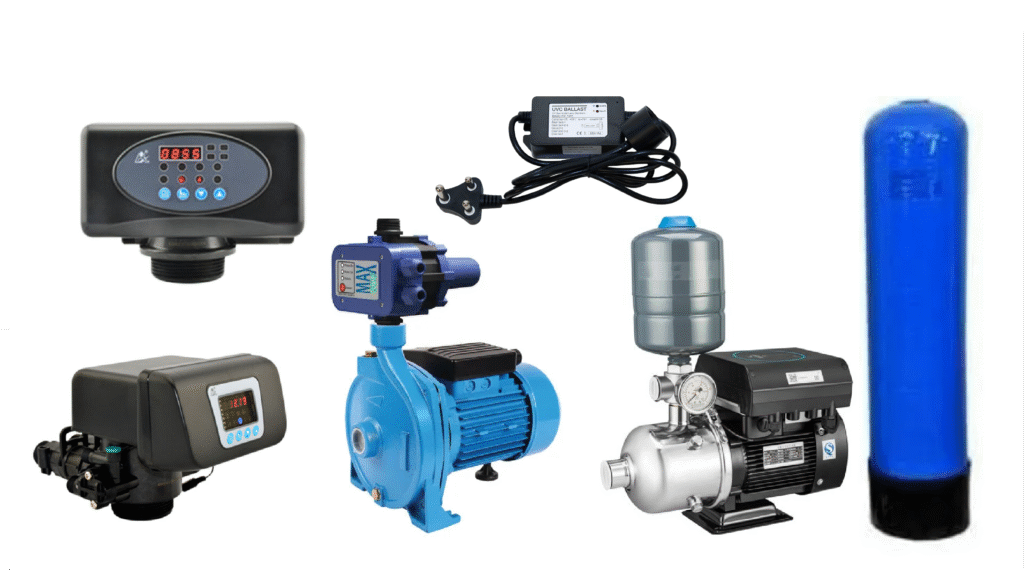
WE REPAIR
We repair backwash heads, UV Ballasts, FRP vessels, pump controllers & pumps
Don’t spend thousands replacing your components and pumps when you can repair them for a fraction of the price.
Features of Water Testing
- Contaminant. Detection – Identifies harmful substances like bacteria, lead, nitrates, chlorine, and pesticides.
- pH Level Measurement – Determines if your water is too acidic or too alkaline, which can affect plumbing and health.
- Hardness Assessment – Measures the mineral content (calcium, magnesium) to prevent scale buildup in pipes and appliances.
- Chlorine & Chemical Analysis – Detects residual disinfectants and other chemicals that may affect taste and safety.
- Heavy Metal Testing – Checks for toxic metals like lead, arsenic, and mercury.
- Microbiological Testing – Screens for bacteria, viruses, and parasites that can cause illness.
- Turbidity & Sediment Check – Evaluates water clarity and the presence of suspended particles.
- Customized Testing Options – Can be tailored based on local water sources, concerns, and needs.
Benefits of Water Testing
- Health Protection – Ensures your water is free from harmful contaminants that can cause diseases.
- Improved Taste & Odor – Identifies issues like sulfur (rotten egg smell) or chlorine, allowing for corrective measures.
- Prevention of Plumbing Damage – Detects corrosive water that can damage pipes and fixtures.
- Appliance Longevity – Reduces wear and tear on water-using appliances by addressing hardness and sediment issues.
- Compliance with Regulations – Helps meet safety standards for private wells or municipal water systems.
- Early Problem Detection – Identifies potential water quality issues before they become serious health risks.
- Cost Savings – Prevents expensive repairs, medical bills, and the need for bottled water.
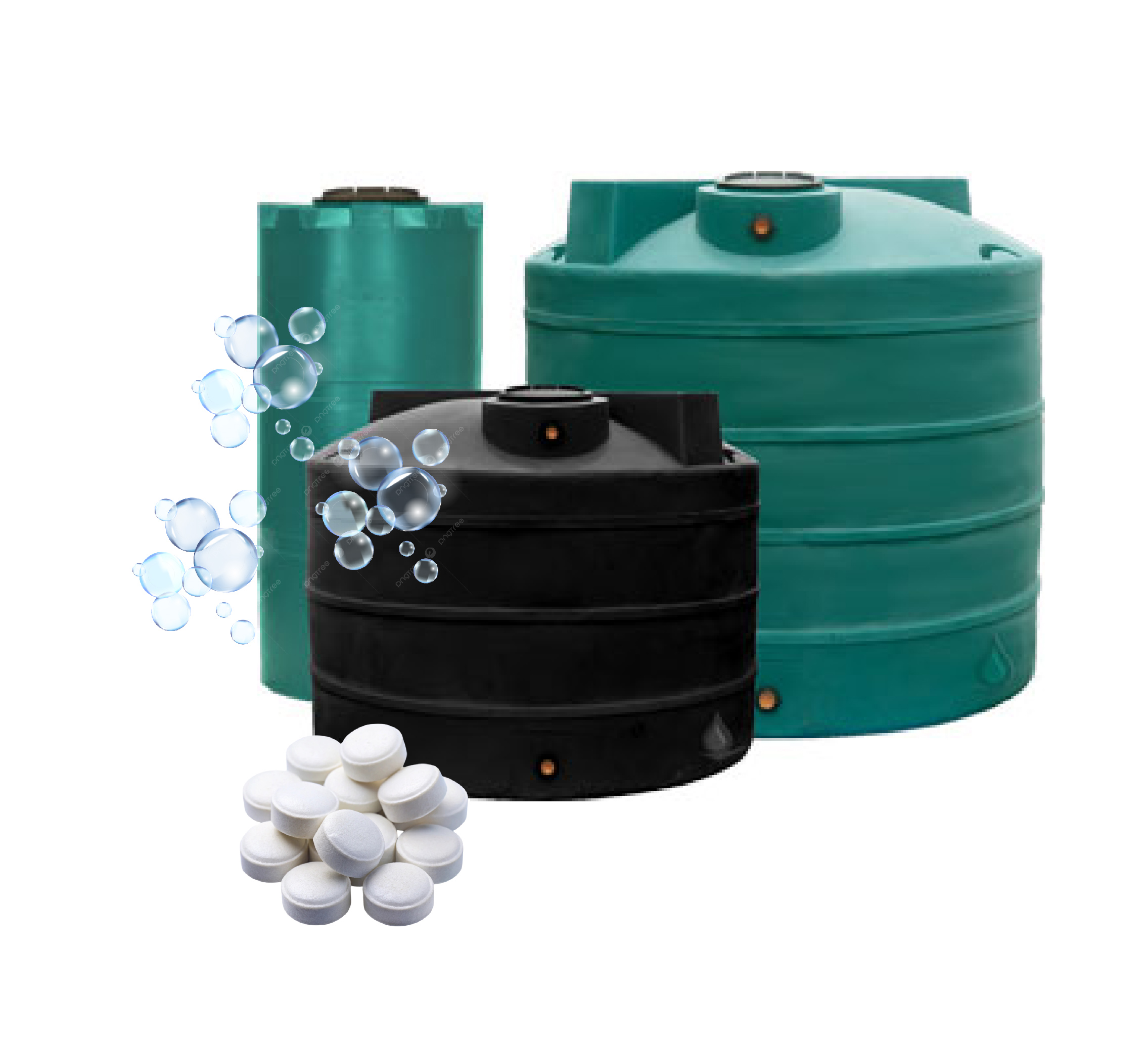
PURITANK
Keep Your Tank Perfectly Fresh & Clean!
Here’s the revised version with transition words added. I also split the long second sentence, so every sentence stays under 20 words:
Keep your tank water in fantastic condition all year round with ease and confidence. In fact, whether you’re using ground water, rainwater or stored municipal water, this solution can help. It keeps your tank water fresh, clean and ready for use, both inside and outside the home. As a result, you can enjoy reliable water quality for a variety of purposes throughout every season.
In addition, the solution offers these key benefits:
- Raises pH
- Helps Remove Iron
- Deters Mosquitoes
- Softens Water
- Kills Bacteria
- Prevents Corrosion
Overall, it is a simple way to protect your tank water and keep it in top condition.
Your Water Quality is our Priority
At SANS Water, we believe understanding your water is the crucial first step before any treatment solution. Consequently, by analysing the water first, we can accurately identify the contaminants, chemical properties and physical characteristics present. In fact, different water sources often contain a wide range of impurities. These include heavy metals, pathogens, organic compounds and excess minerals. Each one requires a targeted treatment method. Without this initial assessment, treatment efforts can become ineffective, expensive and even harmful to health.
Therefore, a comprehensive analysis is not just helpful, it is vital. As a result, we can design a water treatment strategy that is precise, efficient and safe. It is also tailored to the unique characteristics of your water source. Ultimately, this ensures optimal results and long-term water quality improvements.
Drop Us Your Details To Chat About A Water Test or Audit Quote
You can also upload a water test that you may have had done previously and our AI reports generator will send you an easy to understand report detailing the quality of your water and what it is suitable for and what it may be bad for.
That's What You Said...

© 2026 SANS Water | All rights reserved | Terms and Conditions | Design and development by Michael Hastie.
+27 (0) 21 788 1302 | mike@sanswater.co.za
50 Promenade Road, Lakeside, Cape Town, South Africa