mike@sanswater.co.za / call: 0844004300
- Home
- Water Testing
- Pricing
- Our Articles
- The Hidden Journey of Water: Infrastructure, Quality and Risk
- Water Testing Before Water Filtration
- Water Compliance is Key
- Easy To Test Your Drinking Water With Our Water Test Kit
- The Easiest Way To Test Your Water.
- The Advantages of Using Filtered Ground Water in Your Home
- How to Save Water in South Africa: Practical Tips for Every Household
- Essential Guide to Water Testing in Cape Town: Is Your Water Safe?
- Why & How To Cover Your Back When It Comes To Your Water Quality
- SA Water Crisis
- Managing Effluent Water Testing
- SANS 241 Water Testing
- Why pH Isn’t Enough: The Hidden Danger Lurking in Your Water
- Businesses Need To Test Their Water
- Why You Need To Test Your Council Water
- Why Water Testing Is So Important
- Businesses Need A Water Audit
- It Is Vital To Maintain Your Filtration System
- Water Testing For Corrosive Water
- Contact Us
Why Water Testing Is So Important: Your Waters Journey
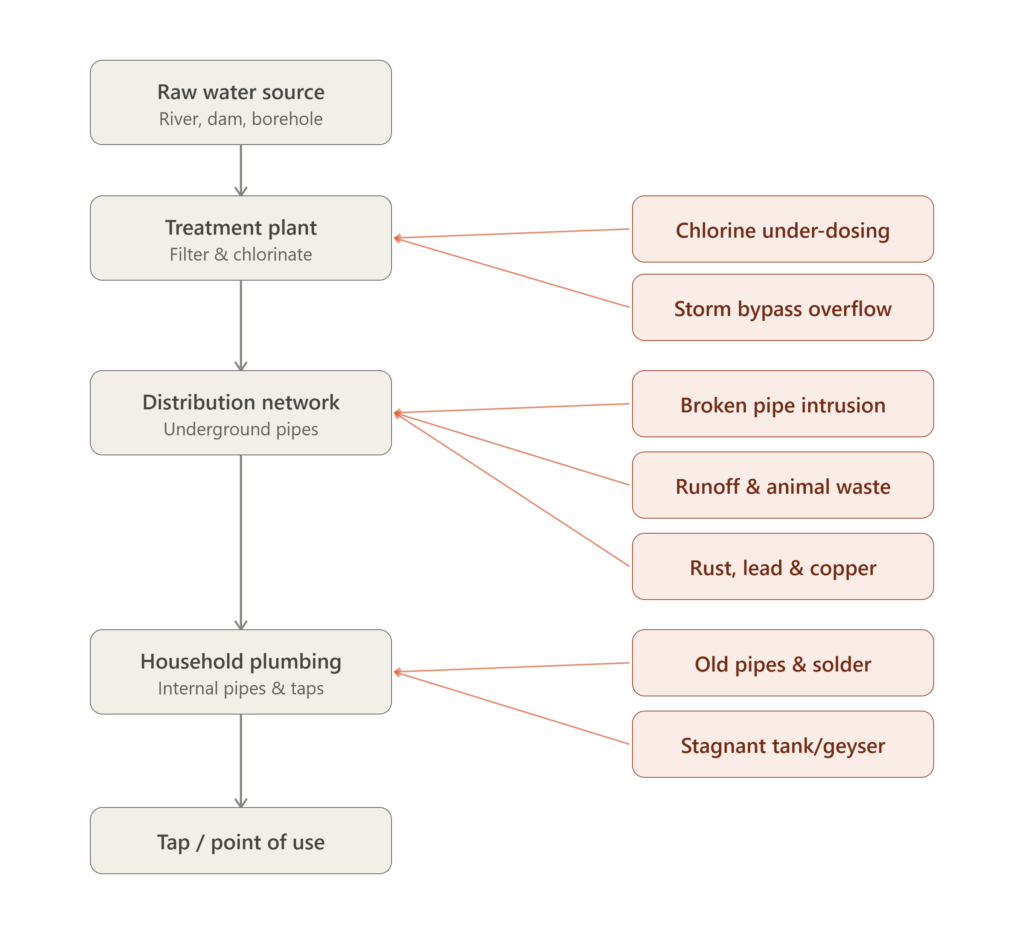
By the time your water reaches your tap, it has passed through several stages where a host of things can go wrong. Understanding this journey is the first step toward knowing why regular borehole water testing for South African homes and businesses matters. Whether that water comes from a municipal line or your own borehole.
In this guide, we walk through the full pipeline, from raw source to point of use, and show where contamination typically enters. We’ll also cover SANS 241, the national drinking water standard, and answer the question we get asked most often: what is the best way to test my water?
Where Water Contamination Begins: The Source
Every water supply starts somewhere — a river, a dam, or an underground aquifer accessed through a borehole. Even at this early stage, water can carry natural sediment, algae, or agricultural runoff washed in from nearby land.
As a result, raw water almost always needs treatment before it’s safe to use. This is true whether the water is destined for a municipal network or drawn privately.
Contamination at the Treatment Plant
Next, water moves into a treatment plant, where it’s filtered and disinfected, typically with chlorine. In theory, this step should remove the vast majority of risks. In practice, however, several things can go wrong here.
Chlorine dosing can fall short during periods of high demand, meaning water leaves the plant under-treated. Meanwhile, during heavy rainfall, ageing plants can be forced into bypass mode, sending partially treated water into the network to avoid system overload. Consequently, water that looks and smells normal can still carry microbiological risk.
This is one of the key reasons municipal water testing exists as a service A plant operating correctly on paper doesn’t always mean water is compliant with SANS 241, the national standard, by the time it reaches a consumer.
Contamination in the Distribution Network
After treatment, water travels through kilometres of underground pipework before it reaches any building. This is where a combination of ageing infrastructure and environmental exposure does the most damage.
Broken or cracked pipes allow soil, fertiliser runoff, and animal waste to seep directly into the supply, particularly where pressure drops and water is briefly pulled backward into the pipe. In addition, old and corroding pipes, many installed decades ago and never replaced begin leaching rust, lead, and copper into the water they carry. None of this is usually visible to the naked eye, which is exactly why it goes unnoticed for years.
Low or intermittent pressure, often caused by loadshedding or mains repairs, makes this worse. When pumps stop, pipes can lose pressure and draw in contaminants through the same cracks that would otherwise only leak outward.
Contamination in Household and Office Plumbing
Finally, water reaches your property but the journey isn’t over. Internal plumbing, especially in older homes and commercial buildings, can reintroduce contamination even when everything upstream was fine.
Old internal pipes, lead-based solder, worn brass fittings, and stagnant water sitting in geysers or storage tanks can all taint water in the last few metres before it reaches the tap. Therefore, testing only at the municipal connection point doesn’t tell you what’s actually coming out of your kitchen or bathroom tap.
Why Borehole Water Testing Matters Too
It’s worth noting that borehole water isn’t automatically safer just because it bypasses the municipal network. Borehole water testing is essential because groundwater can carry its own risks. Bacterial contamination from nearby septic systems, high mineral content, or aggressive, corrosive water that damages pipes and appliances over time. Borehole water should be tested with the same rigour as municipal supply, ideally before it’s used for drinking, food preparation, or bottling.
What Is SANS 241 and Why Does It Matter
SANS 241 is South Africa’s national drinking water specification. It sets the microbiological, chemical, physical, and aesthetic limits that water must meet to be considered safe for human consumption. It’s referenced directly in national water services legislation. You can read more about the standard on the SABS food and water products page.
Compliance with SANS 241 isn’t a one-time achievement. Because water quality can change at any point along the pipeline from the treatment plant to your own taps. Ongoing testing is the only way to know where you actually stand. The Department of Water and Sanitation also publishes broader guidance on water resource management and quality oversight in South Africa.
Best Way to Test My Water
The most reliable approach combines a professional sample collection with laboratory analysis against SANS 241 parameters Don’t use a basic home test strip, which typically only checks one or two indicators. A proper test should cover microbiological indicators (like E. coli and HPC bacteria), key chemicals, and metals such as lead and copper, along with an assessment of the water’s corrosivity.
Where Can I Get My Water Tested
If you’re asking where can I get my water tested, the answer depends on what you need. A one-off compliance check, ongoing monitoring for a business, or an assessment before installing treatment equipment. SANS Water offers professional water testing, municipal water testing, and borehole water testing services across South Africa. Results are interpreted against SANS 241 so you know exactly what they mean for your property or business.
Get in touch with SANS Water to arrange a water test, or explore our borehole water testing and municipal water testing services.
© 2026 SANS Water | All rights reserved | Terms and Conditions | Design and development by Michael Hastie.
+27 (0) 21 788 1302 | mike@sanswater.co.za
50 Promenade Road, Lakeside, Cape Town, South Africa