
mike@sanswater.co.za / call: 0844004300
- Home
- Water Testing
- Filtration
- Pricing
- Our Articles
- Whole House Water Filtration System: Maintenance Guide
- The Benefits of Installing a Water Filtration System in Your Home
- The Hidden Journey of Water: Infrastructure, Quality and Risk
- Water Testing Before Water Filtration
- Water Compliance is Key
- Easy To Test Your Drinking Water With Our Water Test Kit
- The Easiest Way To Test Your Water.
- The Advantages of Using Filtered Ground Water in Your Home
- How to Save Water in South Africa: Practical Tips for Every Household
- Essential Guide to Water Testing in Cape Town: Is Your Water Safe?
- Why & How To Cover Your Back When It Comes To Your Water Quality
- SA Water Crisis
- Managing Effluent Water Testing
- SANS 241 Water Testing
- Why pH Isn’t Enough: The Hidden Danger Lurking in Your Water
- Businesses Need To Test Their Water
- Why You Need To Test Your Council Water
- Why Water Testing Is So Important
- Businesses Need A Water Audit
- It Is Vital To Maintain Your Filtration System
- Water Testing For Corrosive Water
- Contact Us
Whole House Water Filtration System: A Maintenance Guide
A whole house water filtration system needs more than an occasional filter change. Your pump, filter media, pipework and UV unit must work together.
Otherwise, you may experience weak showers, blocked filters or poor water quality. Even worse, water can look clear while still containing harmful microorganisms.
Fortunately, regular checks can help you identify problems early. This guide explains how to maintain your home water filtration system and when to ask for expert help.
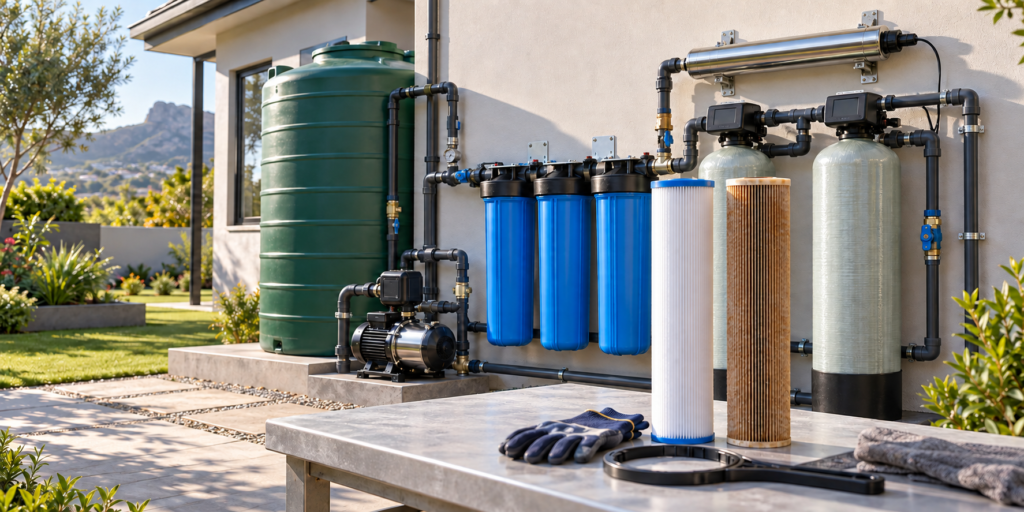
Start With Water Testing Before Choosing Filters
The best water filter for borehole water depends on what your water contains. Therefore, choosing equipment from appearance or smell alone can lead to disappointing results.
For example, a sediment cartridge can catch suspended dirt. However, it will not reliably remove dissolved salts, correct low pH or disinfect water.
Similarly, an iron removal filter needs suitable operating conditions. A UV water purification system also needs adequately pretreated water.
Test first. Then select treatment for the actual results and your household’s peak demand.
Test Both Untreated and Treated Water
An untreated sample identifies the problems entering your system. Meanwhile, a treated sample helps establish whether the system is working.
Repeat testing after commissioning, significant repairs or suspected contamination. Thereafter, agree on a monitoring schedule that suits your source and intended use.
When Should You Change Water Filters?
There is no single replacement interval for every home. Instead, filter life depends on sediment levels, water consumption, cartridge capacity and operating conditions.
Consequently, a filter treating dirty borehole water may block much faster than one treating relatively clean municipal water. Pentair also identifies sediment loading as a reason for more frequent cartridge replacement. Pentair
Signs Your Sediment Filter Needs Attention
Look for:
- Reduced flow at several taps.
- Increasing pressure loss across the filter.
- A cartridge loaded with trapped sediment.
- The manufacturer’s replacement deadline.
- Unusually rapid blocking after rain or borehole work.
However, cartridge colour alone does not establish its remaining capacity. A brown filter may still pass water, while another may restrict flow before looking heavily stained.
Measure Pressure While Water Is Flowing
Install pressure gauges before and after the filtration bank. Then record the readings when the cartridges are new.
Compare future readings under similar flow conditions. Replace or clean filters at the manufacturer’s specified pressure differential.
A pressure reading taken with every tap closed may hide a blocked filter.
Carbon Filters Need a Different Replacement Plan
Activated carbon may reach its treatment capacity without causing an obvious pressure drop.
Therefore, follow its rated capacity, service interval and intended contaminant-removal claims. Do not wait for bad taste or odour to return.
Additionally, keep carbon housings hygienic. Carbon filtration does not replace disinfection where microbiological contamination is a concern.
Tips for Changing Filter Cartridges
First, follow the housing manufacturer’s instructions. A typical procedure includes:
- Switch off the pump and isolate the water supply.
- Release pressure before opening the housing.
- Remove the old cartridge.
- Clean and sanitise the housing as instructed.
- Inspect the O-ring and sealing surfaces.
- Fit the correct replacement cartridge.
- Reassemble, refill slowly and check for leaks.
- Flush the cartridge for the specified period.
- Record the replacement date and pressure readings.
Use only compatible lubricant where specified. Also, wash cartridges only when they are designed to be reusable.
What Sediment Filter Micron Size Should You Use?
A micron rating describes the particle size a filter is designed to capture. Generally, a lower number means finer filtration.
However, finer filtration can also increase resistance and shorten cartridge life. Therefore, putting a very fine cartridge first can create unnecessary maintenance.
Match the Filter Stages to Your Water
The following combinations are starting points for assessment, rather than universal specifications.
| Water condition | Possible starting approach | Main consideration |
| Coarse sand or grit | Suitable separator or washable 50–100 micron prefilter | Remove heavy particles before fine cartridges |
| Moderate visible sediment | Approximately 20 micron, followed by 5 micron | Spread the sediment load between stages |
| Relatively clear water requiring UV pretreatment | A suitable 5 micron stage, subject to the UV manual | Meet the UV unit’s inlet-water requirements |
| Persistent fine particles | Consider a suitably sized 1 micron stage after coarser treatment | Check pressure loss and replacement frequency |
| Heavy turbidity or colloidal clay | Assess specialised clarification or media treatment | Cartridges alone may be unsuitable |
VIQUA generally recommends 5 micron filtration before UV treatment. Nevertheless, the selected UV model’s instructions and incoming water quality must guide the final design. VIQUA
Nominal and Absolute Ratings Are Different
Two cartridges marked “5 micron” may perform differently. Nominal ratings describe an approximate removal performance, while absolute ratings require a stated capture efficiency.
Therefore, compare the technical specifications rather than the label alone.
An ordinary sediment cartridge is not a dependable bacteria barrier.
Cartridge Size Matters Too
Micron rating is only part of the decision. Cartridge dimensions, media area and rated flow also affect performance.
For example, a larger cartridge can provide greater dirt-holding capacity. However, every housing and cartridge must still suit the required flow and operating pressure.
When Should You Get Your Booster Pump Serviced?
Include a booster pump inspection in your annual maintenance plan. However, follow the pump manual for the actual service requirements.
Some domestic pumps are described as maintenance-free. Even so, Grundfos recommends annual or condition-based checks of certain components on its SCALA pumps. Grundfos
Arrange Earlier Attention When You Notice Problems
Warning signs include:
- Frequent starting and stopping.
- Unusual vibration or noise.
- Leaks around fittings or seals.
- Unstable pressure.
- Dry-running alarms.
- Repeated electrical trips.
- Failure to reach normal operating pressure.
However, weak pressure does not always mean the pump needs replacing. Blocked filters, restricted suction pipework or a leaking non-return valve can cause similar symptoms.
What Should a Pump Inspection Include?
A competent technician should check operating pressure, flow, leaks and controls. Additionally, they should inspect suction conditions and dry-run protection.
Where a pressure vessel is fitted, its condition and pre-charge also need attention. Electrical checks should be completed by a suitably qualified person.
Never allow a pump to keep running without an adequate water supply.
When Should You Replace Iron Removal Media?
Iron removal media should be assessed by performance, condition and manufacturer guidance. Therefore, replacing it every year without investigation may waste money.
Investigate Before Replacing the Media
If orange staining returns, check:
- Untreated and treated iron concentrations.
- Incoming pH.
- Required oxygen or oxidant levels.
- Backwash flow and frequency.
- Control-valve operation.
- Media fouling, loss or channel formation.
Sometimes, the media remains usable. Instead, inadequate backwashing or changed water chemistry is causing the failure.
Why Some Iron Removal Media Need a Certain pH
Different products have different operating requirements.
For example, Clack specifies a pH of at least 6.8 for iron removal using Birm, alongside other water-quality conditions. Adequate dissolved oxygen is also necessary.
Consequently, acidic water may need correction before reaching this media. However, those requirements must not be applied to every iron removal product. clackcorp.com
Check Backwash Capacity Before Buying a Vessel
A pump may provide enough flow for showers while failing to backwash a media vessel properly.
Therefore, size the pump, pipework and drain for the media’s required backwash rate. Otherwise, trapped material can accumulate and reduce treatment performance.
When Should You Top Up or Replace pH Correction Media?
Calcite-based pH correction media gradually dissolves as it neutralises acidic water. Consequently, it needs periodic inspection and replenishment.
Consumption depends on water chemistry, water use and operating conditions. Therefore, a fixed annual replacement date cannot suit every installation.
Watch the Treated pH and Media Level
Record the media level after commissioning. Then inspect it at the intervals recommended by the installer.
If the treated pH starts falling, investigate the media level, flow rate and contact time. Also, check whether the incoming water has changed.
Calcite can increase calcium hardness. Therefore, include hardness in the assessment rather than monitoring pH alone. clackcorp.com
What Size Pipe Should You Use for Flow and Pressure?
Pipe sizing depends on peak flow, length, internal diameter and acceptable pressure loss. Fittings, valves and elevation also matter.
A larger pipe reduces friction losses. It does not create pressure.
Why Pipe Labels Can Be Misleading
A pipe marked “25 mm” may not have a 25 mm internal diameter. Its material and pressure class affect the available opening.
Therefore, the following example uses actual internal diameter, rather than nominal pipe size.
| Actual internal diameter | Water velocity at 30 litres/minute |
| 20 mm | Approximately 1.59 m/s |
| 25 mm | Approximately 1.02 m/s |
| 32 mm | Approximately 0.62 m/s |
These figures illustrate how diameter affects velocity. They are not final installation specifications.
Size the Whole Supply Route
Long runs, numerous elbows and restrictive valves increase pressure losses. Meanwhile, filters and treatment vessels add their own resistance.
Therefore, ask your installer to calculate pressure at peak household demand. Include the pump’s suction pipe and the backwash requirements.
Also, ensure municipal and alternative supplies have the required separation and backflow protection.
What Size UV Light Do You Need to Treat Bacteria?
Choose a UV system by its validated treatment capacity, rather than wattage alone.
For example, a “55 W” label does not establish the safe flow rate. Chamber design, lamp output, water quality and exposure time all affect performance.
Match UV Capacity to Peak Flow
Imagine two showers using 9 litres per minute each. A kitchen tap adds another 8 litres per minute.
Together, they require 26 litres per minute.
Therefore, the selected UV unit must deliver the required dose at that flow under its specified water-quality conditions.
A commonly used benchmark is 40 mJ/cm², associated with NSF/ANSI 55 Class A systems. However, the appropriate validated performance must match the treatment objective. VIQUA
Compare Ratings on the Same Basis
Check the dose and UV transmittance conditions behind every flow rating. A capacity quoted at a lower dose is not directly equivalent.
Additionally, consider intensity monitoring, alarms and automatic shutoff where loss of disinfection would create a health risk.
Why You Must Filter Before UV Treatment
Bacteria can attach to particles or become shielded by sediment. Consequently, the UV light may not reach them effectively.
Iron deposits and scale can also foul the quartz sleeve. Therefore, pretreatment must address both suspended particles and relevant dissolved contaminants. VIQUA
Clear-looking water does not automatically mean effective UV treatment.
Maintain the UV Lamp and Quartz Sleeve
Replace the lamp according to its operating-life specification. Many conventional domestic UV lamps require annual replacement.
Meanwhile, clean the quartz sleeve as instructed. A glowing lamp alone does not confirm adequate disinfection performance. VIQUA
How to Prevent Water Storage Tanks Becoming Stagnant
Water tank maintenance starts with keeping contamination out. Therefore, use a suitable opaque tank with a secure lid and screened openings.
Additionally, maintain rainwater gutters, inlet screens and first-flush equipment. Inspect sludge levels and arrange cleaning when necessary. JoJo highlights these checks in its tank-maintenance guidance. jojo.co.za
Encourage Regular Water Turnover
Avoid storing much more water than your household regularly uses. Where practical, design the system so stored water is routinely replaced.
For example, a 5,000-litre tank supplying 500 litres daily has a theoretical turnover of ten days. However, incomplete mixing can leave some water in the tank longer.
Therefore, tank sizing and inlet placement deserve attention.
Can Aeration Help?
Aeration can improve mixing and help manage certain odours. Under suitable conditions, it can also assist iron oxidation before filtration.
However, aeration alone does not disinfect water. Recirculation also does not replace old water with fresh water.
Consequently, combine suitable circulation with turnover, cleaning, testing and appropriate treatment.
Keep Final Disinfection After Storage
Where UV provides final disinfection, position it after storage and the required filtration. Otherwise, treated water can become contaminated again inside a downstream tank.
UV also leaves no disinfectant residual. Therefore, downstream plumbing must remain hygienic.
A Simple Home Water Filtration Maintenance Checklist
| Component | What to monitor | When to act |
| Sediment cartridges | Flow and pressure differential | At the specified limit or replacement interval |
| Carbon filters | Rated capacity and service life | Before capacity or time limits are exceeded |
| Booster pump | Noise, leaks, cycling and pressure | At scheduled inspections or when symptoms appear |
| Iron removal media | Treated iron and backwash performance | Investigate breakthrough before replacing media |
| pH correction media | Media level, treated pH and hardness | Replenish or service as indicated |
| UV system | Lamp age, sleeve condition and alarms | Follow the model’s maintenance schedule |
| Storage tank | Seals, screens, sludge and turnover | Inspect routinely and clean as needed |
Get Expert Help With Your Home Water Filtration System
The right maintenance plan begins with understanding your water. Then, treatment can be matched to your source, household demand and existing equipment.
SANS Water can help with borehole water testing, interpretation and filtration guidance. Whether you need filter advice or a complete system assessment, speak to Mike.
Call Mike at SANS Water on 084 400 4300, or visit www.sanswater.co.za.
© 2026 SANS Water | All rights reserved | Terms and Conditions | Design and development by Michael Hastie.

+27 (0) 21 788 1302 | mike@sanswater.co.za
50 Promenade Road, Lakeside, Cape Town, South Africa